Healthcare marketers are having to navigate massive shifts across the industry, including shrinking ROI timelines and increasingly complex buyer committees.
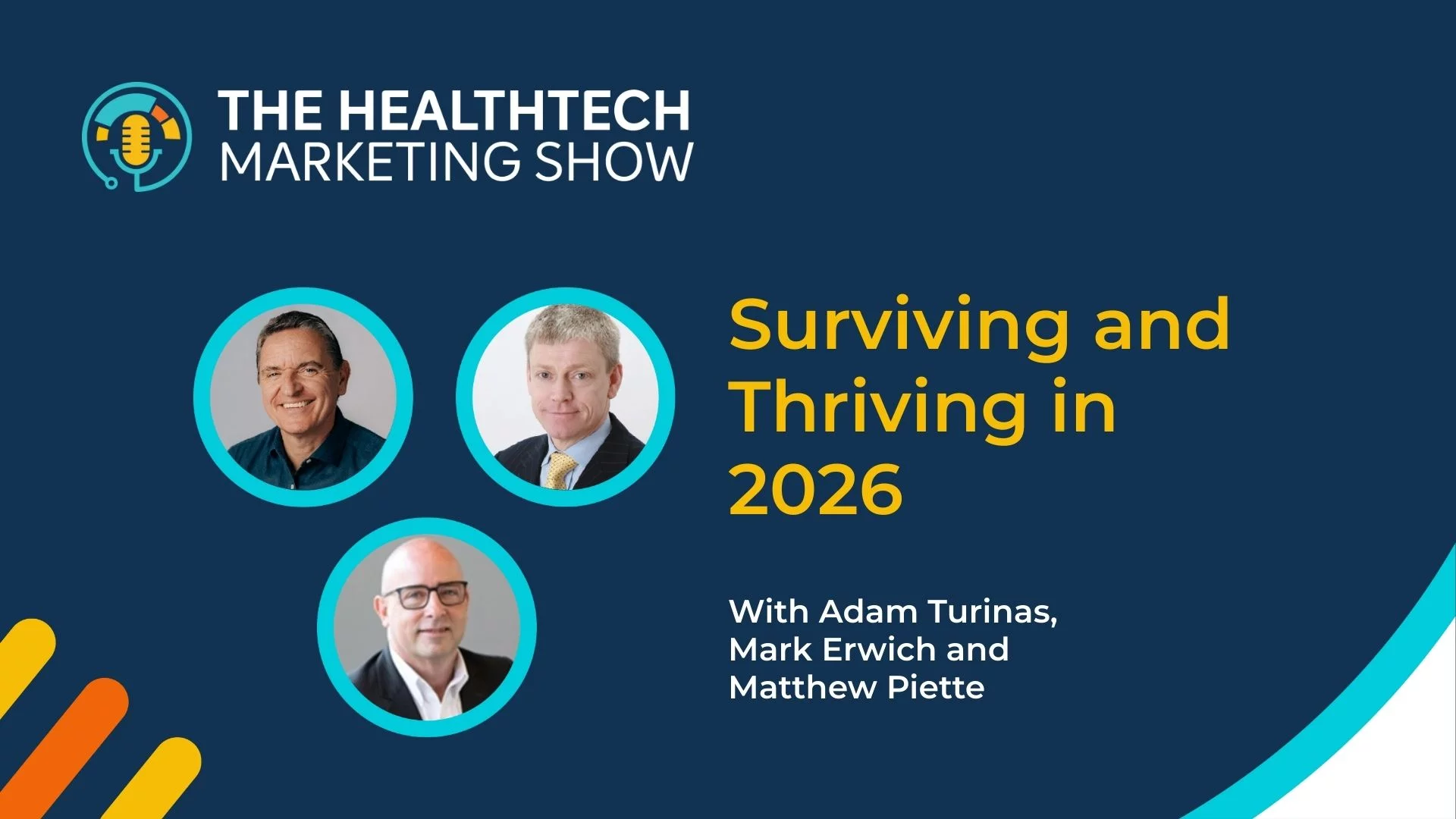
In this episode, I’m joined by my two colleagues and fellow Health Launchpad principals, Mark Erwich and Matthew Piette, for a conversation about what it means to be a marketing leader in healthcare right now.
We explore how the industry is moving from the traditional triple aim toward what we call the quintuple squeeze, where providers face intense pressure from regulatory changes, margin constraints, and severe staffing shortages.
We provide a deep dive into how both health tech and biotech firms can adapt their strategies to remain defensible in front of CFOs. We also share our perspectives on the practical use of AI as an efficiency tool and why focusing on risk reduction may be more important than selling growth in the coming year.
Key Topics Covered
- “(00:00:00) Introduction”
- “(00:09:00) Big Drivers in Healthcare Technology”
- “(00:13:00) The Quintuple Squeeze”
- “(00:15:00) Challenges in Biotech and Life Sciences”
- “(00:16:00) Pressure on Marketing Leaders”
- “(00:17:00) Shortened Planning Horizons”
- “(00:19:00) Biotech Marketing Constraints”
- “(00:21:00) AI: Friend or Foe?”
- “(00:26:00) Impact on Marketing Budgets”
- “(00:30:00) Justifying Your Marketing Budget”
- “(00:34:00) Stop Doing This to Survive”
- “(00:37:00) Five Key Takeaways”
If you are interested in discussing this or any other topic, let’s have a chat. Reach out to me directly to schedule a no-obligation discussion. This isn’t a sales call, but rather an opportunity to talk through your questions and challenges.
Subscribe to The Healthtech Marketing Show on Spotify or watch us on YouTube for more insights into marketing, AI, ABM, buyer journeys, and beyond!
Thank you to our presenting sponsor, HealthcareNOW, 24/7 expert shows, interviews, and podcasts, powering healthcare leaders with innovation, policy, and strategy insights.
Full Episode Transcript
Matthew Piette: [00:00:00] And the way I think about it is that, you know, the, the quintuple aim has become the quintuple squeeze really for
Adam Turinas: golf networks everywhere.
Mark Erwich: In the end, nothing else matters. You can have a great booth at himss. You can have an excellent webinar with 600 people showing up with Beckers, and you can create great content, but if it doesn’t contribute towards pipeline, it’s not defensible.
Adam Turinas: Hello and welcome to the Health Debt Marketing Show. I’m your host, Adam Turinas. I’m the CEO of Health Launchpad, and I wanna thank you for joining us. If this is your first time listening, you can subscribe on any of your favorite podcast application, and you can also find us on YouTube, just search for the Health Tech Marketing Show.
I also want to give a [00:01:00] big thank you to my friends at Healthcare Now Radio. I really appreciate all the support. That you give us, your radio station is amazing and you know, it’s just such an incredible resource for anybody who wants to stay current with everything going on in healthcare. And I’m especially grateful to you for the podcast network that you run, which has dramatically boosted the reach of this show, and we’re getting in front of a lot more people.
Thanks to you Today, I am joined by. My two great colleagues, Matthew Piette and Mark Erwich, they’re both principles in Health Launchpad and longtime healthcare marketing executives. They’ll tell you a little bit about their story. Mark has deep expertise in healthcare technology is multiple times CMO, [00:02:00] and Matthew has an incredible wealth of experience.
In biotech and life sciences, most recently working at Exact Sciences, and they’re gonna provide sort of both their perspectives on what’s going on in healthcare through their respective lenses and what it’s like to be A CMO in healthcare technology and biotech right now. And what some of the things are that they advise.
That if they were back in those seats, what they’d be focused on right now. There’s a lot. There’s a lot we’re gonna cover in this. So with that, let’s get on with the show and introduce you to Mark and Matthew. Mark and Matthew, welcome to the show. So great. We can get the three of us together today. You know, I was thinking about the three of us and I thought it was frustrating.
Say, Hey, we got two things. We’ve got a lot in common, but there are two things that particularly stand out. One is. [00:03:00] All three of us have been in various aspects of healthcare for quite a long time, and so they have a different perspective on it based on the roles that we’ve had. And we’ll talk a little bit about that in a minute.
But the other thing is, is yeah, despite the fact we’re all located here in the US, as the listener will be able to tell, we’re all from somewhere else. So I thought what we would do is maybe kind of what each one of us tell a little bit of our story about. How we ended up in healthcare and how we ended up in the us uh, carry on with mine.
So I actually have a degree in neurophysiology and a kind of a, with a bit of, I did a bit of pharmacology as well. Coming outta university, I had two job offers. One was to go work for a big sexy London advertising agency working on consumer packaged goods and retail and, and all that sort of fun stuff.
And the other one was to go work for Glaxo. As a junior brand manager where I was gonna start by being a salesperson, [00:04:00] and at the age of 21, guess what I went for? I went for the big sexy ad agency and I stayed in the advertising industry on the purely agency side for best part of 20 something years, and didn’t really touch healthcare in all those times.
And then after that I threw a long, boring, convoluted story, which I will s spare the listener. Myself and a friend who are a physician started a healthcare technology company, which is kind of where I learned healthcare, particularly healthcare technology. And we sold that company in 2019, and then I started Health Launchpad because I wanted to go back to my first love, which is marketing.
My second, first love, which is healthcare technology. How I ended up here is I’ve been here for a long time. I’ve actually moved to the US in 1988 because I met a wonderful woman called Alice, who’s an American. I met her in the UK when she was over and after a long distance relationship for a while. [00:05:00] We got engaged and, and I moved over and we got married.
And God, how many years is my old joke? Is I, I would’ve got less for murder. But, uh, we’ve been married for quite, quite a while and still going strong. So that’s why, and I’ve been a US citizen actually since, for about 20 years now. So I consider myself to be. An American, despite the funny accent. Matthew, what’s your story?
Matthew Piette: Yeah, there are some similarities and real differences. Yeah. I’m, as you can tell, I’m also from the UK as a fellow of the British and Asian. Yeah. So I graduated from Cambridge University in English literature and philosophy, which you know, and then you, you graduate and you say. What on earth am I gonna do with this degree?
And I, I guess to look at it on the positive side, it, it does teach you how to do things with work. So I started actually in the PR. Communications area in the aviation industry for British airports, you know, stands to Heathrow, et cetera. And then did a stint in Paris and it was [00:06:00] there that I was recently married and my wife got offered a job of the US government for Voice of America.
She’s A BBC, world service journalist. Oh, I, they offered a job there and we looked at each other and we said, this is the. The only way that we’re probably ever gonna be able to legally come to the United States. So we did. And because it is a land of opportunity and, and we’ve been very grateful for all the years we’ve been here.
So when I landed after stinted a at a think tank in Washington, DC ’cause that’s where Voice of America is, is based, I entered into, you know, corporate America Sprints and then Motorola, then Honeywell. Then Phillips, and it was at Phillips that I entered the healthcare space, became the director of brand brand lead for North America for Phillips, which is a Dutch company, which uh, maybe Mark can talk about later.
And I’ve done a couple of stints in startups. I love to sort of oscillate between, you know, big company and small company innovation. [00:07:00] Most recently, I was at a startup called Thrive Earlier Detection, doing marketing, the founding marketing dude, and they got acquired by Exact Sciences, which is one of the largest diagnostic companies in the United States.
It’s the makers of Cologuard. And they themselves, very recently, they’re in the process of acquisition by Abbott. So I’ve decided to strike out, you know, use the experience that I’ve developed through this wonderful life here in America and apply it to a US-based marketing as a consultant and very happy to be part of Adam’s ecosystem.
So. That’s me, uh, mark.
Mark Erwich: Thank you Matthew, and really happy and excited to be here. My story is slightly different. After I graduated in the Netherlands, I started to work for Apple and, uh, worked for Apple for about nine years, and obviously a lot of transition during that period. Then I started to work for Koft.
Koft was a leader in document imaging and OCR technology. [00:08:00] I was a, originally a spinoff from, uh, Xerox. And scans of got acquired by Nuance, or the name actually got changed towards Nuance is a better way of, uh, presenting that within Nuance. There were various different business units or divisions, however you wanna call it, and.
Initially I did marketing for all of them, and as the company continued to grow, I was asked to select one of the, uh, divisions. I was really fascinated about the, um, healthcare division, and particularly because it was so measurable looking towards the US and very finite markets. Uh, you know, the number of hospitals, there’s no new hospitals being built.
And so, uh, with the, the campaigns that we did, I was very successful and I like this blend of. Creative on one side and really the metrics on the other side and bringing those together. So that got me in towards healthcare and at some point, nuance. I was originally working in the [00:09:00] Netherlands then. Then after some acquisitions, we got one acquisition in Belgium, moved the international headquarters from the Netherlands from Amsterdam towards Belgium.
Worked there for a year or so, and then there was an opportunity to participate in a management exchange program. Now, the original plan was that we moved, would move from Belgium to Boston, stay there for 18 months, and then go back to Belgium, but I’m still in in Massachusetts, and so never got back to Delta.
Adam Turinas: Yeah, that’s great. That’s really, really cool. I, what I love about working with you both is that you both bring a sort of different angle of healthcare, different aspects of healthcare, and what I’d be really interested to hear you both talk about is the subject area expertise that you’ve got, sort of like what your domain is and what you see as the big issues that are going on right now.
What are the big [00:10:00] factors? In those industries. Mark, why don’t you start with your superpower here? Right. So to the
Mark Erwich: provider market, looking towards healthcare technology specifically. I think we have the, a number of different areas that are changing and that have a major impact towards the way that hospitals and IDNs are buying.
One is the constant change in towards. Regulatory new rules coming up with major impact and not immediately clear what the impact would be as the entire C-suite on, okay, what is the implication of this? How do we address that? Two, pressure on margins continue to be a large push in healthcare. We see hospitals struggling with that, and although it was slightly better last quarter, there’s still a major.
Pressure point and that results in towards smaller hospitals suffering [00:11:00] and bigger hospitals looking towards how can they like optimize their mix and look for like more margin, higher margin procedures. And then finally, I would say some of that is immediate and some of that is longer term, but there is an shortage of clinicians, nurses, physicians, and all of that is another big pressure point.
Adam Turinas: So that’s what’s happening at the provider side. What about sort of the next step in the food chain or the value chain in terms of the company selling to them? What, what are the challenges? What, what’s the impact on them?
Mark Erwich: I think they see a number of different things. One is that it’s harder to sell differently, more people being involved in the buyer’s group as a result of that longer discussion, and you really need to rely on your champion to bring your solution in.
Good. Perspective towards [00:12:00] all of those participants of the, the bias group? I think there is conflicting information regarding the length of the sales cycle. We see two different things happening in general’s taking longer, but AI is definitely taking shorter. So AI solutions, there was some reason research from.
Menlo Ventures, they looked specifically towards AI technology in hospitals, shorter sales cycle, because they want to see value now. I think those are the major implications there that we see
Adam Turinas: as a result. It definitely feels like, you know, in the, when I look across. The health tech marketing network and the members of that who are in the main, primarily in sort of selling solutions to providers and payers, is that there are companies that are doing really well.
AI certainly is the predominant part of it. Other companies that have just an absolutely crystal clear ROI,
Mark Erwich: yep,
Adam Turinas: that’s really well aligned with all the, the way that healthcare systems are trying to cut costs [00:13:00] and drive towards the structural changes actually. A
Mark Erwich: hundred percent.
Adam Turinas: Uh, and then other companies that have very valuable solutions, but maybe a couple of years ago would’ve been seen as a must have.
And now sort of drifting into the might, you know, nice to have. Uh, it’s really hard. It’s really hard. Matthew, your background is much more in life sciences and biotech. So paint a picture of that industry, how it’s structured and what are the big drivers.
Matthew Piette: Yeah, I mean, just to echo what Mark said, I mean, many biotech companies are selling, obviously selling into the hospital network, so they’re subject to all those same vicissitudes that Mark was talking about.
And the way I think about it is, you know, the quintuple aim has become the quintuple squeeze really for, for golf metals everywhere. And
Adam Turinas: explain that, just some of it. Yeah, I love that. But explain it a bit. First of all, what’s the quintuple? ’cause it used to be the triple aim then became the quadruple aim.
I’m actually, I don’t think I can say, what is the quintuple aim? What’s the good two, [00:14:00] please?
Matthew Piette: Yeah. The contu aim is, you know, better outcomes, one at lower cost. Two with higher patient satisfaction. Three. Higher staff satisfaction. Four. And a contribution to health equity five.
Adam Turinas: Ah, there you go. I didn’t know what that was.
Okay. That was,
Matthew Piette: so every single one of those is subjects is sort of real capital constraint and difficulty and staff shortages and everything. And biotech is an immune from what’s happening in the health systems world. Having said that, you know, it traditionally has this other avenue of direct to consumer and you’re seeing sort of really positive movement with GLP ones.
And then also oncology is becoming a growth area because people are becoming more susceptible to cancer earlier, for example, with colorectal cancer is now 45 of people below. So the population of those who suffer from oncological malignancies is growing. And that, you know, sounds a little bit profiteering, but that [00:15:00] that increases the market.
Right.
Adam Turinas: Right.
Matthew Piette: So there are some positives and negatives, but you know, there’ve been some major layoffs, let’s say Novartis headquarters recently and a few other. Large companies, but that tend to be more protected from these economic and regulatory changes. I think it’s the midsize to small size biotechs, you know, struggle because they’re often associated with only one technology or, or solution.
And if that goes south, the whole company can go south. So there, there’s a lot of, I think you use the fear of messing up in large parts of the sector. On top of that is, and I think Mark alluded to it, is, you know, some uncertainty at the regulatory level, the F-D-A-N-I-H-C-D-C, the United States Protected Task Force, those sorts of regulatory bodies that have been sort of sleepy, steady state have gone through quite a bit of change recently, which then provides kind of uncertainty in the market in general.
Adam Turinas: Yeah.
Matthew Piette: But you know, biotech is a MIT sector. It’s strong, it’s [00:16:00] growing. But there are some challenges associated with now with marketing into health systems that sort of crosses over with everything that Mark described.
Adam Turinas: Yeah. Got it. Yeah, that makes sense. Alright, so let’s talk about, you know, what things look like from the marketing seat.
So Mark, you know, when you talk to folks who are your peers, who are the marketing leaders, uh, what’s the real pressure they’re feeling? Where’s that coming from?
Mark Erwich: So connecting to the story we were just talking about and what’s happening in the market, it’s really the fundamental shift in the buyer’s mindset, right?
So with these hospitals operating on single digit margins and the economic pressure, regulatory uncertainty, that all combined is forcing the CFOs to dramatically shorten. The planning horizons like, and that immediately has an impact towards the healthcare vendors. You can no longer, shall
Adam Turinas: I explain that?
What does that mean when the CFO [00:17:00] shortens the planning horizon?
Mark Erwich: Yeah. So they are no longer looking towards a five year plan, operating plan for the hospital or IDN. They’re shortening it because of the speed which the economic changes are happening. And the regulatory uncertainty. So those two things combined is basically forcing the CFOs to rather, no longer think long term, but bring it really in shorter term.
Are you
Adam Turinas: talking about the bias CFOs or you
Mark Erwich: Yeah, yeah, yeah. That’s right. Yeah. Yeah. Okay.
Adam Turinas: So the bias, so like CFOs that are healthcare system is saying, basically saying, I don’t care what this. Solutions gonna ha, you know, impact it’s gonna have on our patient wellness, on the patient care. I mean, they’re not gonna say it that way, but what they’re really saying is, is are we gonna be able to see the economic impact of that within a much shorter timeframe?
Not five years, two years, or three years, right?
Mark Erwich: That’s right. Yeah. And they are scrutinizing every purchase through that lens. So that is one [00:18:00] part and what’s making it really hard. Going back towards, hey, what’s the impact for the marketing leaders of health tech firms is like, well, while this CFO is looking for a faster ROI your champion, like the people that you are marketing to still need to sell the solution through a buyer’s committee of what is it?
We’ve heard seven to 15 stakeholders. Right, so that is that that make making it all longer. So it is really proving the value faster is the solution there. But it’s really easy to say that and particularly for like organizations with innovative solutions that are in the startup phase and don’t have that, that proven ROI quite yet in towards the market.
Adam Turinas: It’s really challenging. It’s really, really challenging. Matthew, what are the nuances in the biotechnology and life sciences space with regard to we’re gonna stay in the B2B world, not spend too much time on B2C? It’s ’cause that gets really complicated,
Matthew Piette: right? [00:19:00] Yeah. I think that unlike maybe health tech, biotech doesn’t have the luxury of being able to compress timelines at, at all.
I mean, patients have built into the biotech. Sector for conducting sort of, you know, large scale clinical trials, pivotal trials, et cetera. Interventional trials. Randomized trials. You know, the lifeblood of biotech is proving through evidence that you have a product that A works B doesn’t do harm. Right?
And. To Mark’s point, if you are a biotech leader and you’re trying to sell into a health system, you can’t cut corners. You really, you have to have gotten to a stage where you have credible scientific evidence, and that takes time and energy. I mean, a ma, a massive pivotal trial is very, very expensive. So it’s not for the fame hearted.
I mean, there are ancillary, I guess, adjacent technologies around that sort of core where things can move faster. But generally speaking, [00:20:00] the industry has to do it and do it right o otherwise that can be, you know, like a real disaster, both from a reputational point of view and, and the investment community can, can start to withdraw funds, you know, if you make a single marketing mistake.
And it can be a marketing mistake, not just a sort of failure in the product. If you make a false claim, and we’ve all heard about Theranos, you know where a false claim, yeah. With a fraudulent claim, which is an extreme, but generally speaking, false claims will ruin your reputation, not just with the FDA, but with the entire medical community and, and your peers and everybody else in the ecosystem that you rely on.
So marketing is sort of in a hot seat. It is partnered with legal, medical, regulatory and simply can’t make mistakes. And so there’s no. Point, in fact, it would be rash to rush anything in biotech. So you’ve got that competing pressure of, okay, you know, we’ve gotta prove ROI, we’ve gotta get to revenue, the pipeline growth and the rest of it.
But if we make a mistake, we’re really gonna be in trouble. [00:21:00]
Adam Turinas: That’s a, I, such a, a great point because I mean, in health tech there’s a reputation. If, if you make a false claim, the buyers are gonna see through it, they’re gonna call you to task on it, and then you toast. So it is, it’s existential, but you kinda have to go out of your way, but make it.
Whereas in biotech, it’s existential and worse, right? People can go, I mean, in, in the Theranos case, people go to jail. They went beyond making a a minor mistake. They obviously that was, that was out and out. Institutional fraud, very different. But yeah, the stakes are much higher. You know, it’s like, it’s interesting.
Neither of you mentioned ai and so I’m kind of curious like maybe, you know, Matthew, you could pick this one up, AI friend or foe for the marketer right now.
Matthew Piette: I think it’s both on the content side and the research side, I think it’s helping all biotech companies accelerate and get things right faster. But there is still a lack of [00:22:00] going back to the credibility point, there’s still a lack of faith that AI is compliant.
So you have to la the rinse and repeat your activity with whatever’s generated through ai. From a marketing perspective to get to the sources and citations because your medical legal folks are gonna say, okay, upon what claim or evidence or source is this based? So yes, there are citations in ai, but there’s always that lingering possibility of hallucinations and things being not right.
So the if push comes to shove, biotech companies gonna rely on their own materials, not ai. But for some more, more superficial activities in marketing that it’s obviously a force multiplier where it’s having a really positive effect is in product development as in, you know, digital pathology and detecting kind of anomalies and, you know, genetic sequence mutations and, you know, 10 XA hundred x faster than through all means, or in radiology post [00:23:00] diagnosis.
You know, being able to. Interpret imaging faster and get to diagnostic resolution faster. So it’s this sort of, we love ai, but from a science perspective, but we’re really skeptical about it keeping us safe. The fear of, um, messing up side comes in.
Adam Turinas: That’s, yeah, I, I mean, the distinction is like what you’re talking about from a marketing perspective is really using generative ai.
But this, the si from a scientific expense perspective, it’s, you know, the use of machine learning and, and I guess NLP, you know, in, in the science of developing the product.
Matthew Piette: Yeah, I mean, what marketing folks are relying on is their own IT folks to develop their own instances of copilot and Yeah. And the rest of it, and it’s drawing on, in turn, internally generated data.
And it’s not sharing it.
Adam Turinas: Yes.
Matthew Piette: Showing out, you know, generic. It’s
Adam Turinas: not training them all. Right. Yeah.
Matthew Piette: Yeah. So. So self, self-sufficiency is the name of the game is not depending on the generic AI solutions, but getting [00:24:00] to agent and custom AI platforms.
Mark Erwich: Mark, on the health tech
Adam Turinas: side,
Mark Erwich: what’s ai, friend or foe? So let me give two perspectives.
One is the perspective of people I talk to, and then two is my personal view on that. So I. Here, skepticism and limited use in primarily content creation. And then yeah, we want to do more, but we’re not getting to it is, I’m generalizing a little bit, but that’s most of the answers that I get from marketing leaders now.
My own view is very different. And I take a little bit of, uh, liberty to get to the point here, but I’m really passionate about interns and the concept of internships. I was an intern at Apple during my career at Apple, at Nuance, and any company I worked at, I always had interns. I see. AI as basically an army of interns.
They’re not super smart, but it’s an [00:25:00] enormous amount of manpower available for you at rapid pace, but they need to be instructed very well. And so if I look towards different things that we always need to do in marketing and whether this is research, whether this is list uploads, whether this is looking for attribution, that there is so much work that needs to happen where now AI can like taking that work, which yourself you can’t do.
You typically don’t have the resources there in like the environment that we are in most healthcare, technology, marketing. Teams are lean and here you have a, a tool towards your disposal, which can really help in the efficiency. So that’s my advice there.
Matthew Piette: Yeah, I, I think a couple of comments just to support that.
Yeah, I agree. It’s having this wonderful array of interns in every conceivable topic at the PhD level.
Mark Erwich: Yep.
Matthew Piette: So that wasn’t always the case. The sad side effect of that [00:26:00] is people recruiting less human interns, which I think is gonna have a long-term brother terrorist effect on talent within uh, every industry.
Adam Turinas: I agree. Ironically, though. Intern we hired to help developing our AI stack. So maybe it’s
Matthew Piette: big advice to interns that hey, you know, become your own AI agent and manage
Adam Turinas: Exactly. Get smart on it. And he is great. He is been, he is been really, really helpful. So given everything we’ve just talked about there, what’s the impact on marketing budgets?
Let’s start Matthew with biotech.
Matthew Piette: I think that they will hold steady. I think there’s, you know, there’s downward pressure. What I’m hearing is sort of flat, not growth. So I think we’re in this sort of do more with less with a flat budget environment among biotech companies, which is itself a form of downward pressure because, you know, to [00:27:00] grow, you really need to grow the marketing budget as much as anything else.
But I mean, I, if you put yourself in the shoes of the CFO, who’s really, they’ve got bigger fish to fry. They’re looking at, you know, overall operating costs, cash flow headcount, ROI. General burn rate. The marketing budget is usually a blip. I think there’s generally an underinvestment in marketing except for those you know.
Putting consumer aside except for those that are generating demand through direct to consumer. I think there’s a general underestimate in marketing and there’s an over indexing on sales investments. Marketing has always seems to fast follower of the sales budget. That is usually there’s less ambition to become marketing leaders among biotech companies.
Partly for all the reasons we described is that this really isn’t about, you know, glossy ad production, nor is it about ity metrics around digital execution at scale. Biotech companies are, I think, better [00:28:00] positioned for account-based marketing of looking at each of their customers in a sort of one to few environment, which inherently can be less expensive, but a BM implementation is quite low too.
So I think it’s okay for budgets to stay steady and to be relatively proportionately lower than other operating budgets. I think biotech companies need to wake up to the power of account based marketing as a multiplier for the effectiveness of the marketing strategy
Adam Turinas: in the health tech sector. What I’m seeing is kind of like it’s a bifurcated market.
Some companies are continuing to invest and other companies are slashing, and I’m sure there’s a whole bunch that are sort of keeping, you know, flat is the new up and doing more with less. But I haven’t got sense from what you said there that. That it’s as bifurcated maybe in biotech?
Matthew Piette: Well, I think it’s just bifurcated by company size.
I think that the smaller companies are feeling the pressure and it’s harder for them to even sustain, uh, uh, a [00:29:00] marketing budget. In terms of the pressures that we were talking about earlier, the larger companies, they tend to be portfolio companies. So if one area of marketing fails, another area of marketing will contribute to the bottom line.
Going back to what I was saying before, the smaller biotechs with single. Non portfolio strategies, it’s both more important to get marketing right, but also there’s less resources to do so. So it’s a bit of a squeeze from both ends. Oh, there’s one exception though, Adam, is I think with some of the startups that are going for a quick exit strategy, they are very often tend to put a disproportionate amount of budget into marketing because they’re trying to attract investors and create excitement.
The way that those that have, are not pre-commercial, but have already marketing products, that, that it’s a different attitude.
Adam Turinas: Yeah. Got it. What about on the health tech side, mark?
Mark Erwich: It’s a small band, but then it’s going down. It’s staying flat, it’s going up. I think it’s different categories. What what I [00:30:00] see in research, ai, SaaS, up small percentage, and then the majority of the rest is either flat or down.
Matthew Piette: But
Mark Erwich: it’s not dramatically down. It’s not going down with 25% or so. Those days are over it. It is just like in general, stays relatively flat. So
Adam Turinas: as a head of marketing, what do you need to do to justify your budget? What can you do to protect or even grow it? Mark, let’s stay with you on that and come to you afterwards.
Matthew.
Mark Erwich: Of course, I think there is only one answer to that and that is have focus on pipeline generation. If the head of marketing cannot articulate how his program, how his department, how his team is helping on pipeline generation. Then there is no value for marketing. In the end. Nothing else matters.
You can have a great booth at hims, you can have an excellent webinar with 600 people showing up with Beckers, and [00:31:00] you can create great content. But if it doesn’t contribute towards pipeline, it’s not defensible. So that is easier said than done. I think where it becomes really interesting is those. Heads of marketing that are able to say, okay, I realize that.
So now what do I do with that information? And so the smart ones take that and say, how do I contribute? And getting the numbers from marketing ops team, making sure that there is alignment with rev ops and other teams, and then build a dashboard and share that proactively. Internally with your counterpart, with your CEO, your head of revenue or the head of sales, and making sure that you control the narrative.
Matthew Piette: Yeah, I agree with everything Mark said, and I think the marketer for a biotech company needs to sort of look at two extremes really. One is, I’ve gotta build the brand because I’m not gonna get, you know, citations in AI answers or anything [00:32:00] else. So that a large scale investment in brand building becomes even more important.
And then at the other end of the. The scale becoming a decision support for the buyer committee as opposed to just treating them as anonymous clicks and needs lead, you know, marketing qualified leads so that, you know, really thinking carefully and deeply about the role the marketing has in reducing the regulatory review timelines.
What is its contribution there that’s got nothing to do with clicks and lead gen, right? Optimizing payer discussion similarly, that’s really about presenting the business case for, you know, ultimately improving the quality measure scores for payers and HEDIS and staff for health systems, et cetera.
Again, that’s a sort of a collaborative model. Payers. It’s not, it’s, you know, yes, you need to attract payers that maybe you have no relationship with, but, but once that’s done, it’s really a sort of sit down and work it out as opposed to, you know, just sort of stimulate. And then in health [00:33:00] systems, really getting a, a gathering of KOL leaders to go over the unmet need that you are addressing in health systems.
Similarly with clinicians and HCPs. I think what’s working is shamelessly leveraging your chief medical officer in what you know, emerging field of sort of science to business. Which was more of a, an academic thing, but I think it’s like really critical in biotech to have a fantastic CMO that acts as a, as a spokesperson and leverage that because that’s where the credibility lies.
And then, you know, have your narrative together on EHR integration, how you make it easier for health systems to integrate a, a novel test or a novel drug and de-risk from a commercial perspective. The decision that sales leaders have to make in terms of market timing. I think that the intelligence that marketers bring to when not to go to market as much as when to go to market with something is really critical.
So sometimes, like silence is an element of your brand. [00:34:00] It’s like, hold back, don’t, you know, be careful and come out when the data is there. ’cause if you’ve missed far too early, you only have one chance at an early impression with your KOLs and other people.
Adam Turinas: Very interesting. That’s a great point. Okay, I’ve got final question for you both, and so I’ll start with you Matthew.
So friend of yours who’s A CMO, calls you, calls you one night and says, you know, it’s really tough right now. Everybody’s saying what I should do, what should I stop doing immediately if I want to survive and thrive in the next 18 months?
Matthew Piette: I was gonna say, stop calling me in the middle of the night. I have a life.
No, seriously. I would say the one sentence would be something like, stop selling marketing as a growth lever. Start selling it as risk reduction. I think the article you wrote, Adam, was perfect. The growth will happen. [00:35:00] If the sensitivity and specificity and all the other metrics of the product itself are right for the market.
And obviously you need to show how it is and there’s a good fit for the market, but really engage with senior leadership to talk about how you are removing barriers, redu, removing friction from the revenue pipeline through marketing and just getting away from, oh, you know, we’ve got this fantastic LinkedIn glossy campaign.
Think beyond, way beyond that. I’m not saying that that doesn’t count, it does. But think through the business model, the ROA calculation, the the impact estimator for outcomes at the patient level. Start thinking like your customer. And present to the customer like-minded data as a marketing lead.
Mark Erwich: Mark, how about you?
I would say right now there’s so many variables that are changing, whether it’s internally or externally on competitive side. Hey, the [00:36:00] search volume is down, buyer behavior is changing. There is new products, maybe in new positioning, and so the natural instinct of marketing leaders is, well, we need to address this.
We need to fix this. To Matthew’s point earlier, Hey, you are being asked to do more things. Well, that doesn’t work. You cannot spin up an initiative and a project team to address all of these different problems. You end up spreading way too thin, and in the end, nothing gets done well, your team gets frustrated, and when anybody asks you what’s working, you throw your hands up in the air because you don’t have a clean view anymore.
So. Stop the lower priority stuff, focus on a few. I think that is really the best advice that I could give. You need to stop the lower priority stuff, and then those ones that have the discipline to focus on those fewer things, those are the marketing leaders that will survive.
Adam Turinas: I think that’s a perfect place to end this conversation.
Mark and Matthew, it [00:37:00] was great having you on the show together. I really enjoyed, it’s a great way to spend a Friday afternoon. I hope everybody listening to this has enjoyed this as much as I have and picked up a few tips along the way. So thanks for that. Thank you. Great, thank you. I, what a great conversation.
I certainly really enjoyed it, as you can tell. So thank you Matthew and Mark for sharing your perspectives. I wanna leave you with five key takeaways. So marketing. Is always gonna be judged as a pipeline growth engine, but it’s also now being judged as a way, as part of risk management. If you can’t clearly show how you reduce friction, how you shorten sales cycles, and how you de-risk the decisions for the buyers, and frankly, for your own management.
You’re in for a tough year, I’m afraid. Second. ROI. Timelines are shrinking. Buyers, especially their CFOs, are no longer [00:38:00] gonna accept five year visions anymore. They want to see impact in years or even months. Third, we all love ai, right? But it’s not magic. It is leverage. And the winning right now are the ones that are using it like a, an army of interns doing the kind of unglamorous work faster.
While keeping the humans firmly in charge of judgment, credibility, and compliance. Fourth is focus beat activity. CMOs who thrive are the ones who will stop the lower priority initiatives. Say no more often and concentrate on the few things that actually move the pipeline. And finally, in both health tech and biotech credibility beats creativity.
Fancy campaigns won’t save you clear value. Evidence and alignment with how buyers actually make [00:39:00] decisions is what’s gonna be absolutely critical in 2026, maybe even beyond. So if this all resonated with you, and especially if you know you are feeling the pressure around budgets, ai. Everything to do with marketing, frankly, and particularly proving value.
You know, I’d be happy to have a conversation with you. You can book a call with me in the link down below, and if you, you know, if you think of somebody in your network who might pick up a few words of wisdom from what Mark and Matthew have to say, please go ahead and share it with them. I’ll be very grateful to you.
I’d also be really grateful to you if you would give this episode a thumbs up. Please like it. Please give it a, whatever rating you think it merits on your podcast application. Whatever you do, it’s gonna help more people like you. Get exposed to this content that we’re creating. So with that, I thank you again for listening or for watching, [00:40:00] and hope to see you on the next one.